
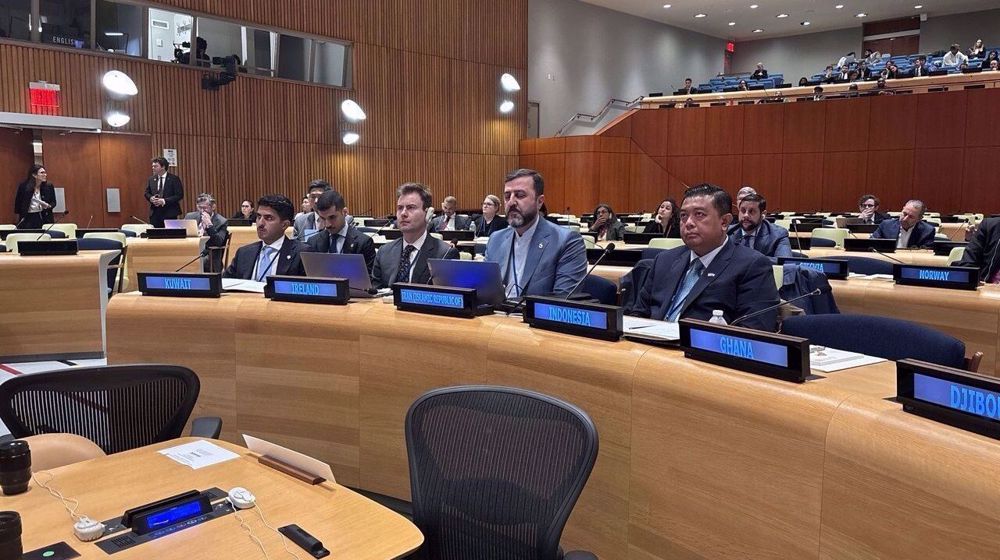
Iran’s deputy Foreign Minister for Legal and International Affairs has stressed the necessity of applying international law equally to all states, without exception, in order to preserve its credibility and promote peace and justice.
“The sovereignty and territorial integrity of states are not subject to violation or bargaining,” Kazem Gharibabadi said at a high-level meeting in defense of international law at the UN on Friday, noting that no state is allowed to set aside the principle of the prohibition on the use of force based solely on political claims or a unilateral perception of a threat.
He warned that no country can preserve its security and sovereignty, if the fundamental principle of Article 2(4) of the UN Charter is undermined.
The Iranian officials stressed the legitimate right of any country subjected to aggression to self-defense “within the framework of the UN Charter and international law”.
He emphasized that principles such as adherence to international humanitarian law, the protection of civilians, and the need to distinguish between military and civilian objects, should be applied without exception, whether in Palestine, Iran, Lebanon, Yemen or any country across the world.
Gharibabadi stated that today’s primary problem is the “selective” application of rules of international law, noting that the UN Charter is invoked in one case, while geopolitical interests are prioritized in others.
He further said that in some cases strict compliance with UN Security Council resolutions is demanded, whereas in others the violations of these resolutions go unanswered.
In one case, investigations and accountability are called for, while in another, political backing obstructs accountability, he added.
“Such an approach not only undermines justice, but also erodes the confidence of nations in multilateralism and international institutions,” Gharibabadi stressed.
Warning that the credibility of international law will be undermined, if it is not applied equally to all states, Gharibabadi emphasized the importance of the International Court of Justice.
“As the principal judicial organ of the United Nations, the Court must be able to adjudicate disputes between states independently of political pressure and clarify their legal obligations,” he said.
The diplomat also expressed Tehran’s readiness to cooperate with countries that believe in the sovereign equality of states, multilateralism, the peaceful settlement of disputes, and the non-discriminatory application of international law to strengthen the multilateral system with the United Nations at its heart.
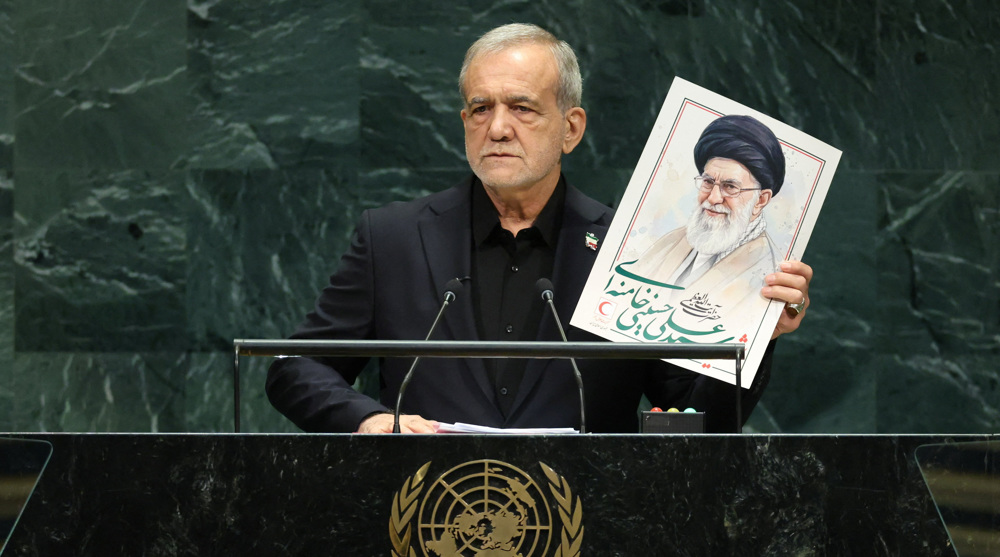
Earlier this week, Iran’s President Masoud Pezeshkian delivered a critique of Western hypocrisy at the UN General Assembly, exposing the contradiction of an Israeli regime armed with nuclear weapons and granted total impunity, while Iran faces relentless inspections and sanctions.
Addressing the assembly, the Iranian official emphasized that trust cannot be built merely through rhetoric, but requires a fundamental abandonment of double standards.
“The atomic bomb and other weapons of mass destruction in this region are in the hands of the Israeli regime; yet inspections are demanded of Iran!” Pezeshkian stated, highlighting the absurdity of the current international order. “Israel massacred 70,000 people in Gaza, yet Iran was bombed at the negotiating table!”
The US and Israel launched another round of aggression against Iran on February 28, some eight months after carrying out unprovoked attacks on the country.
Iran swiftly retaliated by launching barrages of missiles and drones at the Israeli-occupied territories, as well as US bases and interests across the region.
The United States has perpetrated numerous violations against Iranian territory since April 7, when US President Donald Trump announced a unilateral ceasefire in the latest bout of American-Israeli aggression targeting the Islamic Republic.
The violations continued even after Washington and Tehran signed a Pakistan-mediated memorandum of understanding in June, whose first clause clearly mandates cessation of aggression on all fronts.
Renewed US strikes and blockade again triggered Iranian retaliation in the past two months.
 This makes it easy to access the Press TV website