
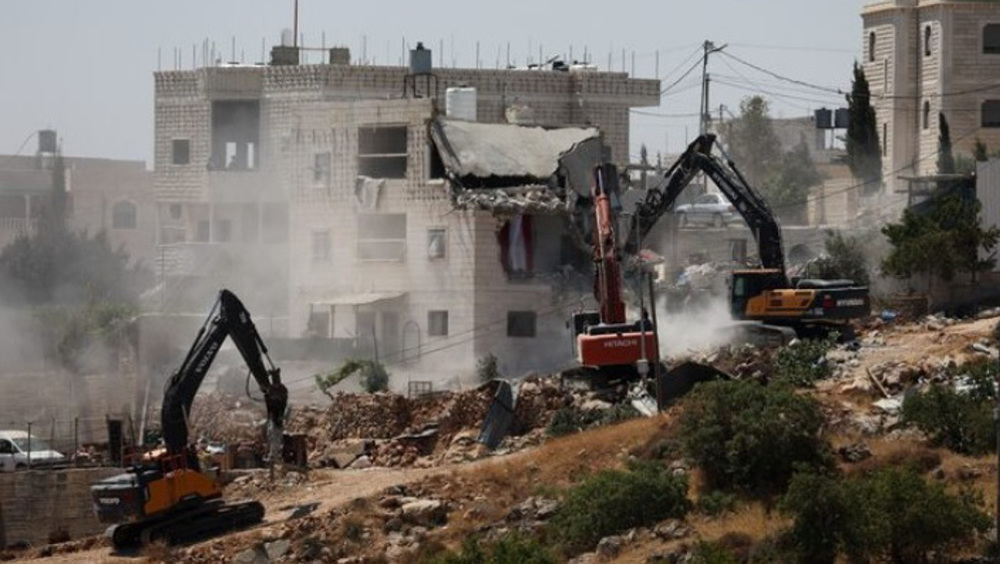
Israeli regime authorities have demolished around 80 homes in the Palestinian village of Al-Dhahiya in the Negev region of the southern part of the Israeli-occupied territories, displacing approximately 400 people.
Israel’s public broadcaster KAN reported that teams from the Israel Land Authority, accompanied by heavily reinforced police forces under Itamar Ben-Gvir’s ministry, carried out the demolitions on Monday in Al-Dhahiya, an unrecognized village north of Rahat, citing a lack of building permits.
The demolitions followed a decision by the Beersheba District Court on Sunday to reject a petition seeking to postpone the demolition. Around 400 people lived in the targeted homes.
In recent weeks, Ben-Gvir has publicly highlighted the demolition of hundreds of homes belonging to Palestinian citizens of Israeli-occupied territories, commonly known as Israeli Arabs, over alleged unauthorized construction.
Last Tuesday, Ben-Gvir participated in the demolition of a five-story building housing 70 Palestinians in the At-Tur neighborhood of occupied East al-Quds. The al-Quds Governorate condemned the move as the “electoral exploitation of al-Quds at the expense of Palestinians.”
The Joint List, an alliance of three Arab parties, denounced the demolitions as “a blatant assault on the most basic human and national rights of our people.”
The alliance said the destruction continued a longstanding policy pursued by successive Israeli regimes of demolishing homes and displacing residents of Arab villages in the Negev.
Hassan al-Nasasra, deputy mayor of Rahat, also condemned the demolitions, describing them as political propaganda rather than law enforcement.
“The demolitions are not an implementation of the law in any way, but merely election propaganda for the racist Ben-Gvir and his group,” he said in a statement.
KAN also reported that Mansour Abbas, leader of the United Arab List, had sent an urgent letter to attorney general Gali Baharav-Miara demanding an immediate suspension of home demolition orders until the elections are over and a new regime is formed.
Israel’s general elections are scheduled for Oct. 27.
Abbas warned against using demolitions for “political and electoral purposes,” arguing that Ben-Gvir’s public statements about participating in such demolitions undermined the integrity of the electoral process and the neutrality of law enforcement agencies.

He said residents of unrecognized villages in the Negev were unable to obtain building permits because of inadequate urban planning, for which he held the occupied entity responsible. Abbas called for a complete halt to the demolition of inhabited homes in the villages.
Dozens of Palestinian villages in the Negev remain unrecognized by Israeli authorities. Homes in these communities are often classified as unauthorized construction, while residents face limited access to basic infrastructure and public services, including water, electricity, roads, schools and clinics.
Last year, Israeli daily Yedioth Ahronoth reported that demolition orders in the region had increased by as much as 400% since the beginning of that year. The campaign drew criticism from Israeli rights organizations, which described it as discriminatory and said it disproportionately targeted the Bedouin community.
Palestinian Bedouins in the Negev are Arab tribal communities whose presence in the region predates the establishment of the occupied Israeli entity in 1948.
Israel was established in 1948 following the displacement of Palestinians during the war surrounding its creation. In 1967, Israel occupied the remaining Palestinian territories, including the West Bank, the Gaza Strip, and East al-Quds.
 This makes it easy to access the Press TV website