
By Press TV Website Staff
Israeli prime minister Benjamin Netanyahu is heading into the October 27 election under the weight of mounting political and strategic debacles, as years of devastating wars across the region have failed to deliver the decisive victories he repeatedly promised.
Three years after the Hamas-led Operation Al-Aqsa Storm on October 7, 2023, exposed a historic failure of Israel’s so-called “security apparatus” and shattered its facade of invincibility, the Palestinian resistance remains a force to reckon with, Hezbollah continues to be formidable in Lebanon, and the Islamic Republic of Iran has emerged as a regional superpower after two imposed wars.
Israel’s genocidal war on Gaza has devastated the besieged Palestinian territory and killed more than 74,000 Palestinians, while deepening the regime’s international isolation. Netanyahu himself faces an arrest warrant issued by the International Criminal Court (ICC).
In the occupied territories, massive missile damage and displacement caused by Iran’s powerful retaliatory operations during the 12-day and 40-day wars have intensified pressure on the embattled premier and his war cabinet. So have mounting anxieties and unresolved questions surrounding the intelligence and military failures of October 7, which continue to give nightmares to Netanyahu.
Netanyahu also remains on trial on domestic corruption charges, which he has been trying to evade.
With polls indicating that his bloc could fall short of a parliamentary majority, Netanyahu faces the prospect of losing power after years of portraying himself as the regime's “indispensable” leader.
An election overshadowed by October 7
The October 7, 2023 operation shattered Netanyahu’s long-standing claim that his leadership and policies could protect the illegal settlers in the occupied territories.
The Hamas-led operation exposed major failures in intelligence, military preparedness, and the response of the so-called “security” establishment.
Following the genocidal war on Gaza, from late 2023 to early 2026, demonstrations, civil unrest, and riots repeatedly shook the Israeli-occupied territories as people protested Netanyahu and his cabinet.
The protests were driven largely by the regime’s disastrous handling of the war on Gaza and its failure to secure the release of Israeli captives held by Hamas in Gaza. Tens of thousands across the occupied territories joined weekly protests against the occupying regime, calling for Netanyahu’s removal.
Netanyahu’s political opponents have also repeatedly pointed out that a prime minister presiding over such a catastrophic failure must be held accountable and removed. His continued presence in office nearly three years later has kept the issue at the center of the election campaign.
Last month, Israeli opposition lawmaker Gilad Kariv demanded Netanyahu’s removal from office, describing it as an “existential need for Israeli society.” Kariv also revealed that Netanyahu is “avoiding dealing with the Israeli army’s investigations into everything that happened on October 7.”
Such calls for his removal have been repeated many times over the last three years.
Other reports have indicated that Netanyahu was warned of a potential large-scale Hamas operation before October 7, but failed to pass the warning on.
Haaretz reported last month that Israel’s Shin Bet spy agency was warned on September 15, 2023, of an impending “earthquake” and a “huge surprise” from Hamas. The warning was relayed to Netanyahu.

Israel’s ministry of military affairs held a meeting two days later, but made no decisions.
After seeing no action, United Arab Emirates President Mohammed bin Zayed spoke directly with Netanyahu for 45 minutes, seeking to convince him that a Hamas operation was likely after Netanyahu had scuttled talks with the group earlier that year.
Netanyahu, however, assured him that he was prepared for anything. Reports that Netanyahu had prior warning of an impending operation but failed to act prompted widespread reactions.
Former Israeli prime minister and opposition leader Naftali Bennett wrote on X that Netanyahu’s ignoring of the warnings is “criminal negligence,” and that is why he is doing everything to prevent the establishment of a commission of inquiry that will expose the truth.
“Netanyahu cannot continue to serve in his position for another minute, and he certainly is not capable of fixing it,” Bennett added.
Moreover, serious international crimes have become inseparable from the prime minister’s legacy because of the genocidal war on Gaza.
The war has devastated Palestinian homes and infrastructure, displaced people on a massive scale, and inflicted an enormous civilian death toll.
Israeli forces continued to occupy roughly two-thirds of Gaza, reconstruction had barely advanced, and more than 1.2 million people faced acute hunger. More than 1,400 Palestinians had also been killed by Israeli fire since the so-called ceasefire began on October 10, 2025.
International condemnation has intensified, while the ICC has issued an arrest warrant for Netanyahu over war crimes and crimes against humanity.
Over the past three years, the Israeli regime has also faced growing international restrictions and isolation in response to its war on Gaza. Several countries have suspended or restricted arms exports, transfers of military equipment, or licenses for specific weapons.
Other measures have targeted military shipments, trade with Israeli settlements in occupied Palestinian territory, and economic cooperation.
For example, on September 8, 2026, 12 countries — the UK, France, Canada, Denmark, Spain, Finland, Ireland, Iceland, Norway, Poland, Portugal, and Sweden — announced plans to introduce or support trade restrictions on goods from Israeli settlements in the occupied West Bank.
While the scope of these measures varies, they reflect mounting international pressure over the humanitarian consequences of the war.
War on Iran and limits of Netanyahu’s military strategy
Israel’s unprovoked and illegal war of aggression against Iran, backed by the United States, has become another major political liability for Netanyahu.
An Israeli survey published in June found that just 15% of respondents viewed Israel as the winner of the war, while 37% believed Iran had won and 43% considered the outcome inconclusive.
Only 24% believed Iran’s nuclear program had been significantly damaged, while 69% thought it had sustained only minimal damage or none at all. These figures undermine claims that the aggression delivered a clear strategic victory.
Iranian missile strikes also brought the war directly into Israeli homes and communities.
During the June 2025 war on Iran, more than 15,500 Israelis were evacuated from their settlements under emergency orders, according to official Israeli regime figures.
In June 2025, Israel’s Tax Authority reported nearly 40,000 compensation claims in just two weeks. Officials said compensation for damage had reached approximately NIS 4.5 billion ($1.5 billion), while 25 buildings faced demolition.
The Jerusalem Post reported in March that the regime had approved emergency grants for residents whose homes were damaged and declared uninhabitable following Iranian missile attacks.
By October 2026, Israel had paid approximately NIS 38.6 billion ($12.7 billion) in compensation for direct and indirect war damage since October 2023, covering about 1.18 million claims for destroyed property, lost revenue, and other damage across three years of fighting. These figures include multiple fronts and cannot be attributed to Iran alone.
During the 2026 war on Iran, approximately 196,000 people received unemployment benefits after being placed on unpaid leave, with payments totaling around NIS 1.16 billion, according to Israel’s National Insurance Institute.
On October 9, Ynet reported that Israel’s military chief had warned US officials that renewed fighting with Iran could force the October 27 election to be postponed.

Continued fighting along the Lebanese front
Hezbollah launched military operations against Israel on March 2 in response to US-Israeli aggression against Iran, repeated Israeli violations of the 2024 ceasefire, and the continued Israeli occupation of southern Lebanese territory.
Since then, despite months of negotiations, Israel has continued its military offensive against Lebanon, killing 4,386 people, wounding 12,413 others, and displacing more than one million, according to Lebanese authorities.
The offensive has continued despite a US-sponsored framework agreement signed on June 26 between the Beirut government and the Tel Aviv regime. The agreement outlined a gradual withdrawal of Israeli occupation forces from Lebanese territory in return for the deployment of the Lebanese army.
The secretary-general of the Lebanese resistance movement Hezbollah, Sheikh Naim Qassem, dismissed the agreement as illegitimate, unlawful, and humiliating.
The continued fighting on the Lebanese front further undermines Netanyahu’s claims of having restored “security.” As of September 8, almost 40% of Kiryat Shmona’s 24,000 residents had yet to return. Many of those who had returned were older and more economically disadvantaged.
In its June survey, INSS found that 81% of respondents believed the “security situation” north of the occupied territories did not provide settlers with adequate safety.
Earlier, in April, 62% of Israeli respondents said they doubted that the war on Lebanon would provide long-term “security and calm.”
Economic pressure and domestic divisions
Rising living costs, disputes over military conscription, and divisions over religion and public policy have created additional pressure on Netanyahu’s coalition.
A September survey by an Israeli think tank found that 38% of Jewish respondents considered the economy and cost of living among their two most important considerations in deciding how to vote.
The same survey found that 27% prioritized conscription policy, while 26% cited relations between religion and the regime.
The conscription dispute is particularly divisive because exemptions for ultra-Orthodox Jewish men have long angered Israelis who believe the burden of military service is unfairly distributed. After years of fighting across multiple fronts, the question of who serves, who is exempt, and who bears the personal cost of war has become even more politically sensitive.
Public confidence in the political system is another concern. The September survey found that 68% of Jewish respondents considered the events of October 7 a central factor in their voting decision.
The findings point to deep public uncertainty over both political leadership and the regime’s much-touted “security” situation.
Netanyahu’s rivals seek to capitalize on the crisis
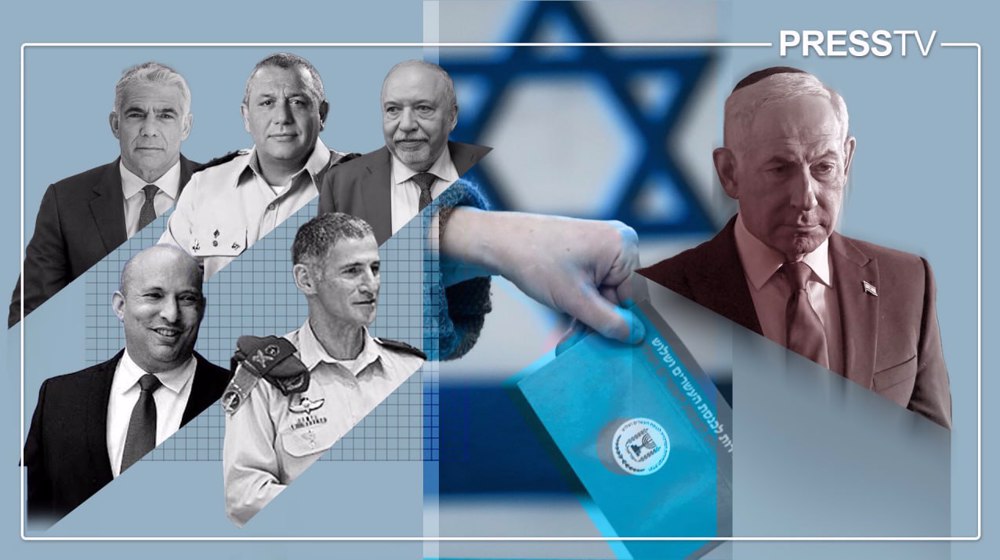
The opposition comprises politicians with sharply differing ideological positions, but its challenge to Netanyahu has become more consequential as the election approaches.
The leaders of four major Zionist opposition movements met on September 26 and signed a declaration pledging not to attack one another during the election campaign and to cooperate in forming a new war cabinet after the vote.
The meeting included Yair Lapid, who leads the official opposition in Israel’s Knesset; Gadi Eisenkot, who heads the Yashar party; Bennett, who leads the Together alliance, co-founded by Lapid; Avigdor Lieberman, who heads Yisrael Beiteinu; and Yair Golan, who leads the Democrats.
Four rival Israeli political movements have agreed to work together in an effort to unseat Netanyahu, the longest-serving prime minister in Israel’s history. The factions span different parts of Israel’s political spectrum but say they are united in their goal.
In a joint statement, the figures said defeating Netanyahu was their “shared highest objective.”
The declaration does not set out an official leader, although Eisenkot is viewed as the opposition’s most likely candidate for prime minister, whose war-mongering record is darker than Netanyahu's.

Of the four opposition parties, Yashar is projected to be the strongest. A recent poll by Israel’s Channel 12 suggested Yashar would win 23 seats in parliament, the most of any party and more than the 21 seats projected for Netanyahu’s Likud.
Trailing is the so-called Together alliance, projected to win 13 seats, followed by Yisrael Beiteinu and the Democrats, each projected to win nine. That would give the opposition a combined 54 seats in the 120-seat Knesset, seven short of a majority.
Netanyahu’s alliance, which includes several ultra-Orthodox and far-right parties, is projected to secure 49 seats.
Arab-led parties, which represent Palestinian citizens of the territories occupied by Israel and make up about 20% of the population, are projected to win 13 seats. However, most leaders of the Jewish-led opposition bloc have ruled out joining forces with them.
Despite their differences, the opposition leaders have an opportunity to capitalize on public frustration. Yet their common opposition to the prime minister does not mean they share a unified position on the Palestinian question, settlements, wars on Iran and Lebanon, or the future of Gaza.
A change of leadership, therefore, would not automatically amount to a fundamental change in the policies that have fueled decades of Israeli genocidal actions.
Yashar’s Eisenkot, a former Israeli military chief, has called the idea of a Palestinian state “delusional,” and he supports “strengthening” Israeli settlements.
On Gaza, Eisenkot supports pursuing a United States-backed peace plan but only from a place of “strength” and only after “Hamas’s total disarmament.”
Lapid, a key part of Netanyahu’s coalition cabinet from 2013-2014, is also a staunch backer of Israel’s illegal settlement enterprise in the occupied West Bank and East al-Quds.
In February, Lapid said that he supports expanding Israel’s borders “as broad as possible” as described in the Bible, including not only all of Palestine, but Egypt, Lebanon, Syria, Jordan, Turkey, Iraq, and Saudi Arabia.
Lapid has said his guiding principle regarding the occupied Palestinian territories is to ensure “maximum Jews on maximum land with maximum security and with minimum Palestinians.”
Bennett, a former Likud member who served in multiple Netanyahu-led cabinets, has described himself as “more right-wing” than Netanyahu and advocated exceptionally draconian policies in Gaza, including once calling for a “shoot-to-kill” policy against Palestinians trying to cross into Israeli-occupied territories.
Bennett staunchly opposes a Palestinian state and supports settlement expansion. With respect to the future of Gaza, he wants Israeli forces to stay in the besieged territory until Hamas is “disarmed.”
Lieberman’s Yisrael Beytenu party also supports settlement expansion. On Gaza, his party wants Israel to retain “freedom of action”, cut off water and electricity, and eventually transfer governance to “an agreed-upon international entity.”
Golan’s Democratic Party is the only one to support a form of so-called “two-state solution,” although it frames it as “responsible separation” that includes the “full demilitarisation” of the Palestinian state and complete Israeli control of the Jordan Valley and other key areas.
His party also supports complete demilitarisation for Gaza and a reconstruction process that involves regional states.
Netanyahu enters the October 27 election burdened by a series of political liabilities: the security failure of October 7, the devastating consequences of the genocide in Gaza, doubts about the outcome of the war against Iran, continued fighting on the northern front, corruption allegations, and deep domestic divisions over the economy and military conscription.
The Israeli regime is also facing growing international backlash, including from its allies, over its continued attacks on Gaza and Lebanon, settlement expansion in violation of international law, and settler violence in the occupied West Bank.
According to many observers, the rivals are likely to capitalize on Netanyahu's failures to unseat him, and are very likely to have a more hard-nosed position on wars across the region.
 This makes it easy to access the Press TV website