

By Mohammad Molaei
On October 9, 2026, US President Donald Trump claimed in a social media post that Russia has agreed to immediately supply approximately 300,000 metric tons of diesel to the United States and global markets, followed by 500,000 tons in November, another one million tons thereafter, and a further three million tons within a relatively short period.
The announced total is approximately 4.8 million metric tons, but the timing and destination of all these deliveries remain uncertain, raising multiple questions.
The supposed “deal” comes as US diesel prices remain above $6 per gallon and the November 3 midterm elections approach, making Trump increasingly desperate and irate.
Its central promise is straightforward: more Russian fuel could increase supply and ease prices. The critical question, however, is whether Russia can deliver these volumes while its refining industry is under repeated Ukrainian attack, and whether the additional fuel is large enough to make a meaningful difference in a market as vast as the United States.
The numbers behind Trump’s claim
Diesel weighs differently depending on its specification, but one metric ton is approximately equivalent to 7.4–7.5 barrels. Using 7.45 barrels per ton, Trump’s proposed shipments translate into the following volumes:
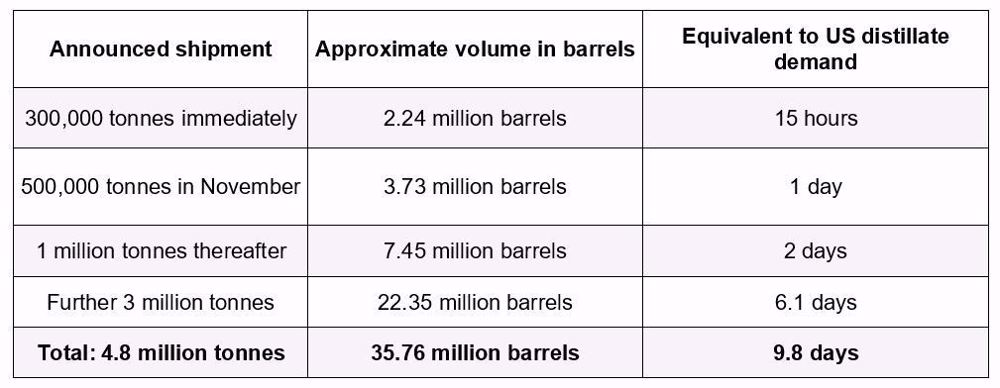
These comparisons use recent US distillate fuel-oil consumption of approximately 3.65 million barrels per day. This category includes diesel and other distillate products, so it is a useful broad measure of the market rather than a perfect measure of road diesel alone.
The first shipment of 300,000 tons is therefore equivalent to less than one day of US demand. If all of it went to American buyers, it would cover approximately 15 hours of consumption.
In practice, Trump announced supplies for both the United States and global markets, meaning the entire initial volume is not necessarily destined for American consumers.
A common numerical confusion also needs correcting. Two million metric tons of diesel would represent roughly four days of US distillate demand, not four to six hours.
Two million barrels, by contrast, would cover approximately 13 hours at the recent consumption rate. The units matter: confusing tons with barrels dramatically distorts the scale of the deal.
The full 4.8-million-ton commitment looks more substantial, but only under a restrictive assumption. If every barrel reached the United States, it would equal roughly one-third of a typical month’s distillate demand.
Yet the shipments are scheduled over an unspecified period, and some of the fuel is intended for international markets. The total headline figure cannot be treated as an immediate injection of 35.76 million barrels into the US market.
Russia’s refining capacity under attack
Russia has extensive refining infrastructure, with installed crude-oil refining capacity estimated at approximately 6.7 million barrels per day. But nameplate capacity is not the same as actual production.
Ukrainian drone attacks have repeatedly damaged critical refinery equipment in Russia, particularly in the recent months, while repairs have been complicated by the difficulty of obtaining specialized components.
By the end of August 2026, estimates indicated that approximately half of Russia’s total refining capacity was offline. Other assessments placed outages at around 40% at the end of July, equivalent to approximately 2.7 million barrels per day of capacity.
Applying the later 50% estimate to the national total suggests that about 3.35 million barrels per day of refining capacity could have been unavailable at that point.
These figures describe disrupted crude-processing capacity, not the volume of diesel alone that Russia had lost.
The scale of the strikes is equally important. At least two-thirds of 36 major Russian refineries, meaning at least 24 facilities, were hit between April 1 and August 31. Some were struck as many as five times.
In a separate tally, at least 194 successful attacks on Russian refineries had been recorded from the start of 2026 by early July, around 11 times the number recorded over the same period in 2025.
The figures measure different things: 194 is a count of attack incidents, while 24 of 36 refers to facilities hit during a defined period. They should not be added together or mistaken for the number of refineries destroyed.
The industrial effect depends on where drones strike. Refineries rely on equipment that removes salt and water from crude oil, separates it into different fractions, and processes those fractions into finished fuels.
Damage to an important distillation unit can disrupt an entire facility even if other parts remain intact.
Of 54 refinery strikes examined in detail between April and August, more than half appeared to have damaged critical desalting or distillation units. Repeated attacks can also occur faster than repairs can be completed.
The result is a serious obstacle to Russia’s export promises. It is not enough for Moscow to possess refineries in theory; it must have functioning equipment, suitable crude, available workers and logistics, and enough finished diesel to satisfy both domestic demand and foreign contracts.

How much diesel is Russia actually producing?
Russian diesel production recovered to approximately 170,000 metric tons per day in August, equivalent to around 1.27 million barrels per day using the same conversion factor. That is a significant volume, but it is total daily production, not the amount Russia can freely export.
The difference becomes clearer when domestic requirements are considered. Deliveries to Russia’s domestic market fell from approximately 5 million tons in July to 4.7 million tons in August. Meanwhile, exports to Kazakhstan, Kyrgyzstan, Mongolia and Tajikistan exceeded 370,000 tons in August, more than twice the previous month’s amount.
Those exports were possible despite restrictions on sales to most foreign markets because some destinations benefited from specific exceptions.
Russia was therefore still able to export diesel, but its export system was operating under constraints. Domestic fuel shortages and high prices had already prompted the government to restrict exports.
In July, total Russian seaborne exports of refined petroleum products fell to approximately 1.18 million barrels per day, down from 1.51 million barrels per day in June. By August, refined-product exports had recovered to approximately 1.229 million barrels per day, but remained 42% below the same month of 2025.
These figures cover refined products collectively, not diesel alone, and demonstrate how unstable export flows had become.
Against this background, the promised US-bound supply would compete with several priorities: restoring damaged production, maintaining domestic distribution, rebuilding inventories and meeting existing export commitments.
A shipment of 300,000 tons is approximately 1.8 days of Russia’s current total diesel production. The full 4.8-million-ton package represents roughly 28 days of production at 170,000 tons per day, even before accounting for Russian consumers and other buyers.
That calculation does not establish that Russia is incapable of delivering the fuel. A country can draw on inventories, redirect cargoes or increase output as facilities return to service. But it shows why the promised schedule cannot be evaluated simply by looking at Russia’s overall production capacity. The decisive measure is the quantity of surplus diesel available for export after domestic needs are met.

Can Russian Diesel meet American demand?
Recent US distillate fuel-oil demand has been around 3.65 million barrels per day, or roughly 111 million barrels in a 30-day month. At approximately 7.45 barrels per metric ton, that represents about 14.9 million metric tons per month.
The initial Russian shipment of 300,000 tons would cover approximately 2% of one month’s US distillate demand if every ton went to the United States. The additional 500,000 tons would represent around 3.4%.
Even the entire announced package of 4.8 million tons would amount to only about 32% of one month’s demand – and that comparison assumes all the fuel reaches US buyers, despite the stated intention to serve global markets as well.
Russia’s present diesel production, meanwhile, is approximately 1.27 million barrels per day, around 35% of the recent US distillate-demand figure. But that does not mean the United States needs Russia to supply one-third of its fuel.
The United States is itself a major producer and exporter of refined petroleum products. Russian deliveries would be an additional source of supply, not a replacement for all domestic production or a solution to the entire American market’s needs.
Nor does adding barrels automatically reduce retail prices by the same proportion. Prices depend on international supply, refinery margins, transport costs, inventories and the timing of deliveries. If the Russian cargoes arrive slowly or mostly go to other countries, their direct impact on American availability will be smaller still.
Diesel prices were around $6.28 per gallon in mid-October, compared with approximately $3.68 a year earlier. The surge reflects a broader international supply squeeze, triggered by the US war against Iran and the effective closure of the Strait of Hormuz.
Financial-market estimates have suggested that the Russian arrangement might reduce global diesel prices by only around $1–$2 per barrel, a modest change relative to the scale of the price increase.
The numbers therefore point to a limited conclusion: Russian fuel could help at the margin, but it is unlikely to produce a dramatic, sustained fall in US diesel prices by itself.

The election factor: Big announcement, uncertain result
The timing is politically significant. The US midterm elections are scheduled for November 3, less than a month after Trump’s announcement.
High fuel prices are an easily understood measure of economic pressure, and diesel costs affect not only truck drivers but also freight rates, agriculture, construction and the prices consumers eventually pay for goods.
The supposed “deal” gives Trump a visible action to promote: a presidential deal with Moscow, a large headline figure and a promise of additional supply. Its political message arrives immediately, while the economic consequences depend on deliveries that may take considerably longer.
The initial 300,000 tons alone would cover only about 15 hours of US distillate consumption if allocated entirely to the country. It is not a volume capable of transforming the market overnight.
Events after the announcement also underline the uncertainty. By October 13, diesel futures had risen by about 4.5%, while the US national average retail price remained around $6.28 per gallon. Daily price changes cannot prove that the deal will fail, but they show that the announcement has not, by itself, delivered an immediate reversal in the market.
The electoral incentive is credible, but the evidence does not establish that winning votes is the only purpose. The more defensible conclusion is that the timing gives Trump an opportunity to demonstrate action on fuel prices ahead of an important election for his party. Whether that message translates into political gains depends partly on whether voters experience actual relief before they cast their ballots.
The arrangement also offers Russia a potential economic advantage: additional export opportunities and revenue at a time when refinery damage and domestic shortages have constrained its fuel trade.
The wide gap between perception and reality
The arithmetic exposes the main limits of Trump’s diesel promise. The initial 300,000 tons equates to about 2.24 million barrels—roughly 15 hours of US distillate demand.
The full announced 4.8 million tons equals approximately 35.76 million barrels, or 9.8 days of demand only if every barrel is delivered to the United States.
Meanwhile, around 40–50% of Russian refining capacity was estimated to be offline at different points in late summer, at least 24 of 36 major refineries had been hit between April and August, and Russian production had recovered to approximately 170,000 tons of diesel per day without restoring full export flexibility.
Russia may deliver some or even much of the promised fuel, but its capacity to do so on the announced timetable is constrained by damaged infrastructure, domestic requirements and competing buyers.
The United States could benefit from additional global supply, but the volumes and delivery uncertainty make a major reduction in domestic diesel prices unlikely on the basis of this deal alone.
The central distinction is between a large political headline and a measurable market outcome. Trump has announced a deal that can be presented as action against high fuel prices just weeks before the midterms.
The numbers, however, show that the economic effect is likely to be incremental, conditional and dependent on actual shipments. Until the fuel arrives and prices respond, the agreement is better understood as a limited addition to global supply with clear political significance rather than a solution to America’s crippling diesel crisis amid the war against Iran.
 This makes it easy to access the Press TV website