

Turkish parliament has ratified the so-called “Mecca defense pact” among Saudi Arabia, Pakistan, and Turkey, despite warnings from opposition parties against falling into the US-Israel “trap” and endangering Turkish soldiers’ lives.
On Thursday, 279 members of the 600-seat parliament voted for the agreement and 119 against.
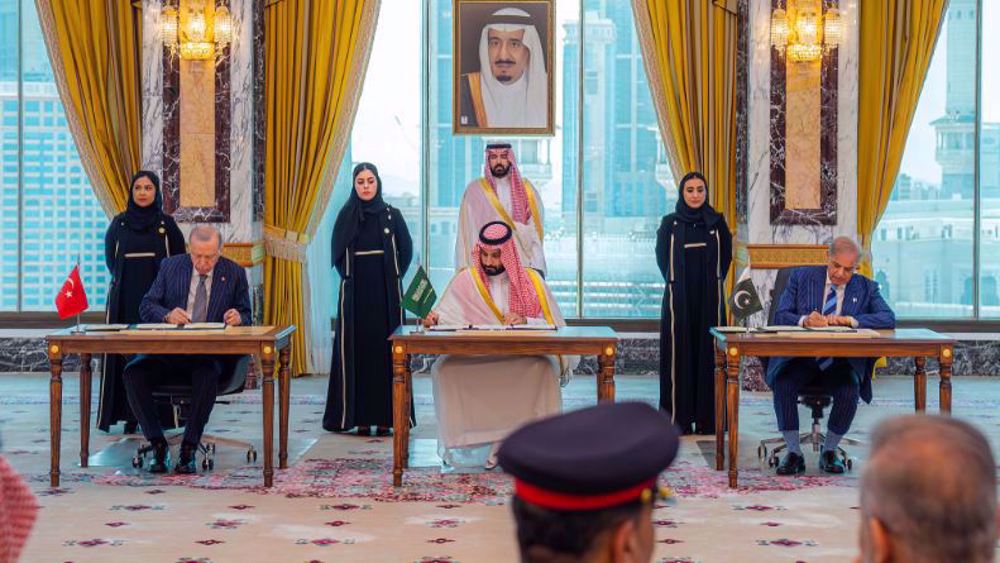
The Mecca Joint Defense Agreement was signed in August by Saudi Crown Prince Mohammed bin Salman, Turkish President Recep Tayyip Erdogan and Pakistani Prime Minister Shehbaz Sharif, with the three countries seeking to strengthen security and defense cooperation.
The agreement stipulates that an armed attack against any one of the three signatories would be considered an attack against all three.
The agreement came as Yemen is conducting retaliatory attacks against Saudi Arabia, and amid a possible new escalation in the US-Israeli imposed war on Iran.
“They brought this agreement to send Turkish soldiers to the deserts of Yemen,” said Murat Emir, deputy leader of opposition New Party lawmakers.
Fuat Oktay, chairman of parliament’s foreign affairs committee and a member of President Recep Tayyip Erdogan’s ruling party, said Ankara would “not be drawn into an uncontrolled process against its will.” He noted that the deployment of troops would only be possible with a separate approval by Turkey’s parliament.
Last month, several Turkish political parties, including İYİ Party, the Antalya branch of Vatan Party, and the Republican People’s Party (CHP), condemned the pact, warning it exploits the sentiments of Muslims to support the Saudi aggression against Yemen and serve the interests of the US and Israel.
The US and Israel launched another round of aggression against Iran on February 28, some eight months after carrying out unprovoked attacks on the country. Iran swiftly retaliated by launching barrages of missiles and drones at the Israeli-occupied territories, as well as US bases and interests across the region.
The leader of İYİ Party -one of the largest opposition parties in Turkey, Musavat Dervisoglu noted that the agreement's name, "Mecca", the home of Islam's most important mosque and holiest site, the Masjid al-Haram, was chosen deliberately to appeal to religious sentiment.
Dervisoglu called on Turkish people not to "fall into the trap of the US-Israel alliance that has descended upon the Middle East".
Saudi Arabia has repeatedly tried to stoke religious sentiments of Muslims by accuing Yemen of launching drones towards the holy cities of Mecca and Medina, which Sana'a has vehemently rejected.
Tensions have been heightened between Riyadh and Sana’a since July when Saudi warplanes bombed Sana'a airport returning from Tehran.
The Yemeni forces have carried out retaliatory attack on targets deep inside the kingdom, announcing that Saudi airspace and airports were unsafe, while excluding airspace over Mecca and Medina.
The war traces back to March 2015, when Saudi Arabia and a US-backed coalition launched a sweeping military aggression and blockade aimed at reinstalling a favorable regime in Sana'a.
Despite years of bombardment and the deployment of advanced Western weaponry, the Saudi coalition has failed to achieve its stated objectives.
Utilizing their advanced asymmetric naval capabilities, including drones and missiles, Yemen has shifted from a purely defensive posture to an active pressure campaign.
The strategy is designed to inflict direct economic and military costs on the Saudi regime until the siege is permanently lifted, the war is ended, and Yemen's full sovereignty is restored.
 This makes it easy to access the Press TV website