
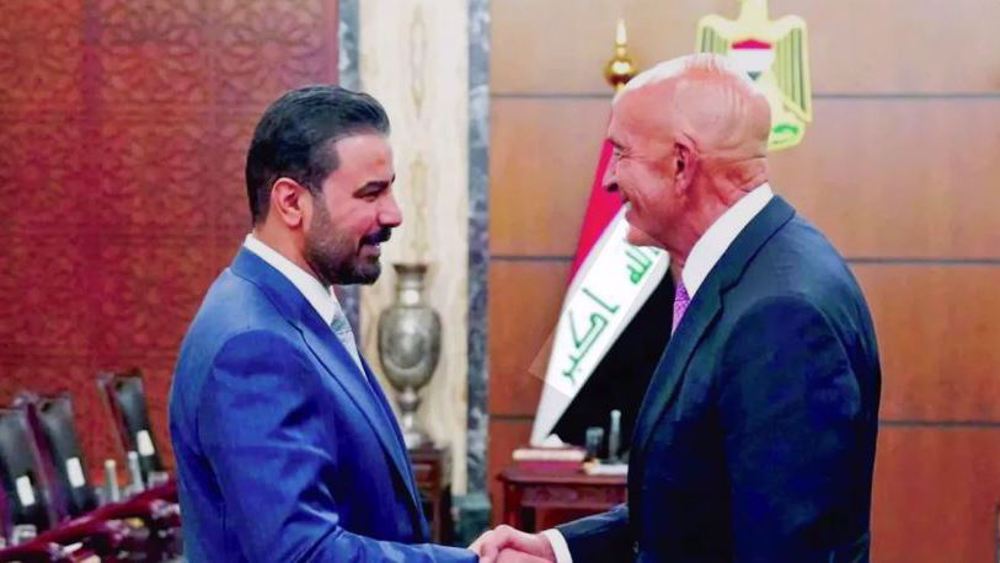
Former Iraqi minister Wael Abdul Latif has warned that new US-Israeli schemes could threaten the Arab country's security and sovereignty following US envoy, Thomas Barrack’s visit to Baghdad.
Barrack's meeting with Prime Minister Ali Faleh al-Zaidi on Monday took place less than two weeks after the US-led occupation formally ended its military mission in Iraq.
Following the meeting, Latif warned Iraqi political forces of a “new and dangerous scheme being prepared behind the scenes."
Barrack’s visit to Baghdad also coincided with intensive US and Israeli air force maneuvers in Iraqi airspace.
Latif described the timing as an indication of political and security arrangements Washington is seeking to impose on Baghdad.
He urged Iraqi leaders and resistance to take a firm stance against the moves that could violate the country’s sovereignty.
Iraqi resistance forces reported four US aircraft violating Iraqi airspace on Sunday from bases in Jordan and occupied territories, despite Baghdad’s declaration ending the occupation.
The Iraqi government has not issued a public clarification confirming the reported maneuvers or specifying their nature.
Previously, Israeli forces had established a temporary military outpost in Iraq’s western desert during the US-Israeli war against Iran, which began on February 28, 2026.
The Associated Press, citing Iraqi and US officials, reported at the time that Israeli forces had built a staging area near Nukhaib to support air raids against Iran.
On March 4, Iraqi forces investigating reports of an unauthorized military presence came under an aerial attack that killed one Iraqi fighter and wounded two others, according to Iraqi military officials.
The incident raised serious questions about the security of Iraqi territory amid an unprovoked, and illegal war against a neighboring country.
The warning unfolded against a backdrop of Iraqi official assertions of restored sovereignty.
Brigadier General Sabah al-Numan, spokesman for the Commander-in-Chief of the Armed Forces, said Iraq had regained full security sovereignty and now relies on its own capabilities for all military operations, including airstrikes.
However, the United States maintains its malicious meddling in Iraq, especially through control over its oil money, and by using the release of Iraq’s own funds to force Baghdad to act according to Washington’s will.
In April, The Washington Post reported that the Trump administration had suspended shipments of US currency affecting about $500 million in proceeds from Iraqi oil sales, as Washington sought to influence the formation of the new government.
Trump had publicly opposed the reelection of former Prime Minister Nouri al-Maliki, threatening to cut off US support for Iraq if he returned to office.
Ali al-Zaidi subsequently emerged as the consensus candidate after months of political deadlock, amid US pressure over the premiership.
During al-Zaidi’s July visit to the White House, Trump praised him as “a great leader in the Middle East” and declared, “Mark my words, I knew what I was doing.”
Al-Zaidi is scheduled to visit Saudi Arabia on Wednesday, following an earlier postponement after US-Saudi airstrikes struck Iraqi resistance groups in July, killing at least 20 fighters.
The visit comes as Saudi Arabia, a close US ally, has renewed its military aggression against the people of Yemen.
Abdul Latif’s warning adds to concerns that US diplomatic pressure and reported military activity could further undermine Iraq’s ability to make independent decisions on its security and foreign policy.
 This makes it easy to access the Press TV website